Writing
Use clear, specific language suited to the reader. Review meaning, structure and wording before delivering any text, including titles, labels and short replies.
When it happens. Before any long document or substantial section: a concept note, a service sheet, a manual, a funding proposal, a speech, a mission report, a ministerial note. Also whenever a text « sounds like AI » and nobody can say why.
Keep the requested or established tone. For a new document, use a plain register suited to its purpose. Ask about tone only when the audience or task leaves an important choice unresolved.
The eight registers
1Plain functional
The reports module receives progress from the field and passes it to the Promotor.
Subject, verb, object. No hook, no frame. For readers who come looking for one fact.
Risk: flat over a long document. Repair it with good section titles, never with ornament in the body.
2Working question
Who answers a report from the field? The Promotor, at eleven points in the cycle.
Opens on the doubt the reader actually brings, and answers it at once. A question someone would say out loud.
Risk: tiring if repeated. At most one opening in three.
3Opening in a scene
An officer in Caquetá files a report. Three days later a signed answer arrives.
Starts inside the action, with a real place. The frame comes after, if at all. The scene is remembered long after the figure.
Risk: the scene must be true and checkable. Never invented people with names in an institutional document.
4Before and after
Today nobody knows who answers a field report. The Promotor cycle settles that.
The problem first, in its most concrete form; the solution as the answer. The natural register of a funding proposal.
Risk: the « before » must be documented. Exaggerate the problem and the technical credit goes with it.
5Institutional
The present section sets out the functions of the Promotor across the management cycle.
The register of a signature: impersonal, subordinate clauses, fixed terminology. Correct for what is signed, cited and annexed.
Risk: used anywhere else, the reader leaves. Keep it for what is actually signed.
6Spoken to the reader
If you are a Promotor, this is your path: what you receive, what you decide, to whom you return it.
Second person, addressed to one role. The register of the user manual and the role guide.
Risk: it needs one audience. With three audiences in one section it collapses.
7Consequence first
No field report goes unanswered. Eleven steps make that true.
The result in the first sentence, the mechanism after. For readers who read two paragraphs and decide. Right for an executive summary.
Risk: the consequence must be defensible. Never promise what the system does not do.
8One sustained image
The wheel turns in four quarters. The green one belongs to the Promotor.
A single image governs the whole document and every section returns to it. Works when a real diagram sits in front of the reader.
Risk: one image, held to the end. Mixing two (wheel, engine, bridge) destroys the text.
Which register for which document
| Document | Default |
|---|---|
| Concept note, donor proposal, fundraising | 4 or 7 |
| Ministerial signature, note verbale, legal annex | 5 |
| User manual, role guide, service sheet | 1 or 6 |
| Technical process documentation, specification | 1 |
| Speech, presentation, opening of a session | 3 |
| Executive summary inside a long document | 7 |
| Training material | 6 |
| Public or web communication | 3 or 8 |
Forbidden in all eight
Announcing the shape before giving the content. No « eleven steps, four moments », no « in three parts ». The reader already sees the contents. The first sentence says what the thing does, not how big it is.
Titles built on a colon. « From end to end: where the Promotor acts. » A plain title, or a naming title, never hook plus precision.
Closing on fidelity. « Told as it happens », « in their own words ». If the text is faithful it shows; announcing it weakens it.
Empty threes. « It is fast, it is simple, it is yours. » Three items only when all three carry different information.
Deny-then-affirm. « It is not a form, it is a channel. » Say what it is.
Long dashes as rhythm, and bare noun phrases used as a drum beat: « Eleven steps. Four moments. One owner. »
Figures where they earn their place. « Eleven steps » in the body, where the reader can count them, yes. In the opening, as an announcement of size, no.
How it is held
Fix it first, then write everything in it. Consistency matters more than the choice: a whole document in register 1 reads better than one alternating 3, 5 and 7 by section.
The finishing check. Read only the first sentence of every section, one after another. If they sound like different authors, repair them before delivering.
Converting an existing text. The register lives in the openings, the transitions and the closes. Change those; never touch figures, proper names, legal references or fixed technical terms.
Mixed audiences. A note with a donor summary and a technical annex may take one register per section, but only if it is decided in advance.
Review before delivery
Check meaning first: the text answers the reader’s need, facts are supported and qualifications remain. Then check structure: titles are clear, emphasis follows importance and each section adds information. Finally check wording: remove filler, inflated claims, invented labels and needless repetition.
Balanced slogans, decorative counting, forced contrasts and repeated triples are examples of poor writing. The broader test is whether each phrase adds meaning. Keep genuine comparisons, useful lists, accurate technical terms and required formal wording.
For edits, remove additions that contribute nothing. Keep the original wording when it was already clearer. Preserve quotations and exact wording requested by the user. Review silently; provide scores or explanations only if requested.
The global writing policy applies in every register and visual mode. non-ai-style helps choose a register when needed. writing-unslop provides a deeper review. The phrase checker flags candidates; it cannot judge the whole text.
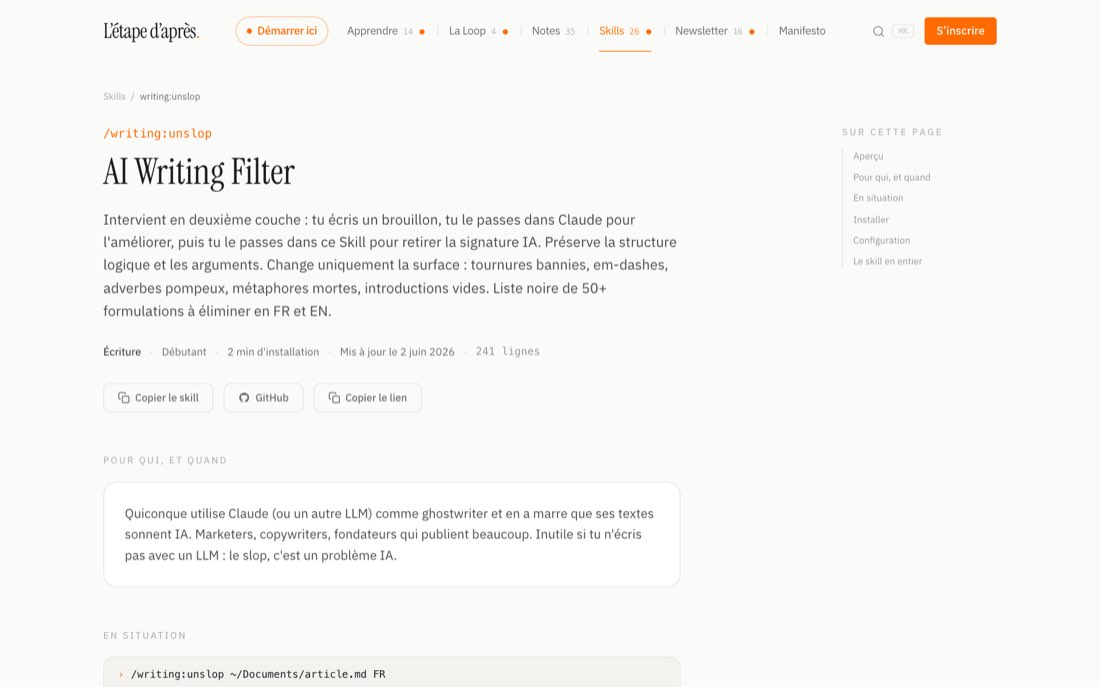
Where it comes from. 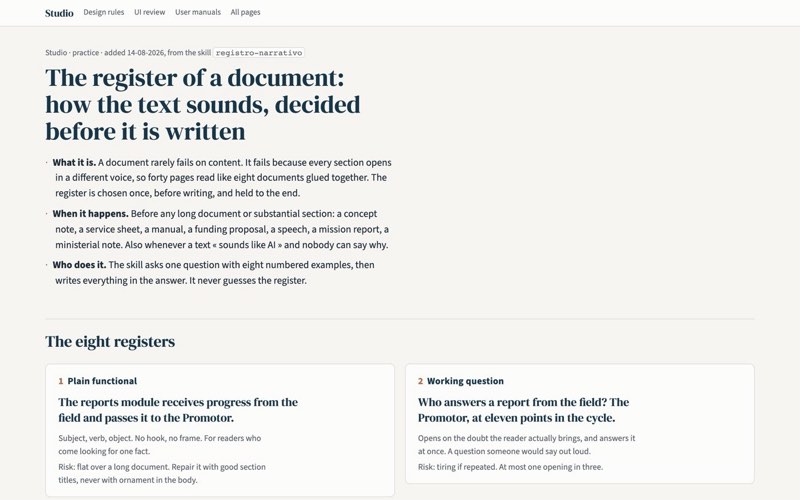 L'étape d'après, installed here 15-08-2026. It works on a file, on pasted text, or on the address of a published page, including text written by someone else.
Write for the task, review the draft and correct it before delivery. The same review applies when text is produced through code or a document tool.
 The page review
 The design rules